
Andreas Hammerschmidt
1611-1675

The first half of the 17th century in England was a period of relative calm before it was shattered with the outbreak of the Civil War.
In the rest of Europe the world was being turned upside down by the religious wars known as the 30 Years War in most of Europe and the 80 Years War in the Netherlands.
Throughout this time Central Europe in particular was characterised by people fleeing religious persecution by either Protestants or Catholics.
Which is how Hans Hammerschmidt, a saddler by trade from Brux in Saxony ended up bringing his family to Freiburg am Breisgau on the edge of the Black Forest. Lutheran Protestants, they fled for their lives Saxony when it became Catholic.
Very little is known of the education of his son Andreas. In fact very little is known of his upbringing full stop.
In Freiburg the musical prowess of the young Andreas proved sufficient to get him the job of organist to the local count at the tender age of 22. He served as organist until 1639 when, newly married he moved again to Zittau when the post of organist became vacant. He would remain in the town for the rest of his life.
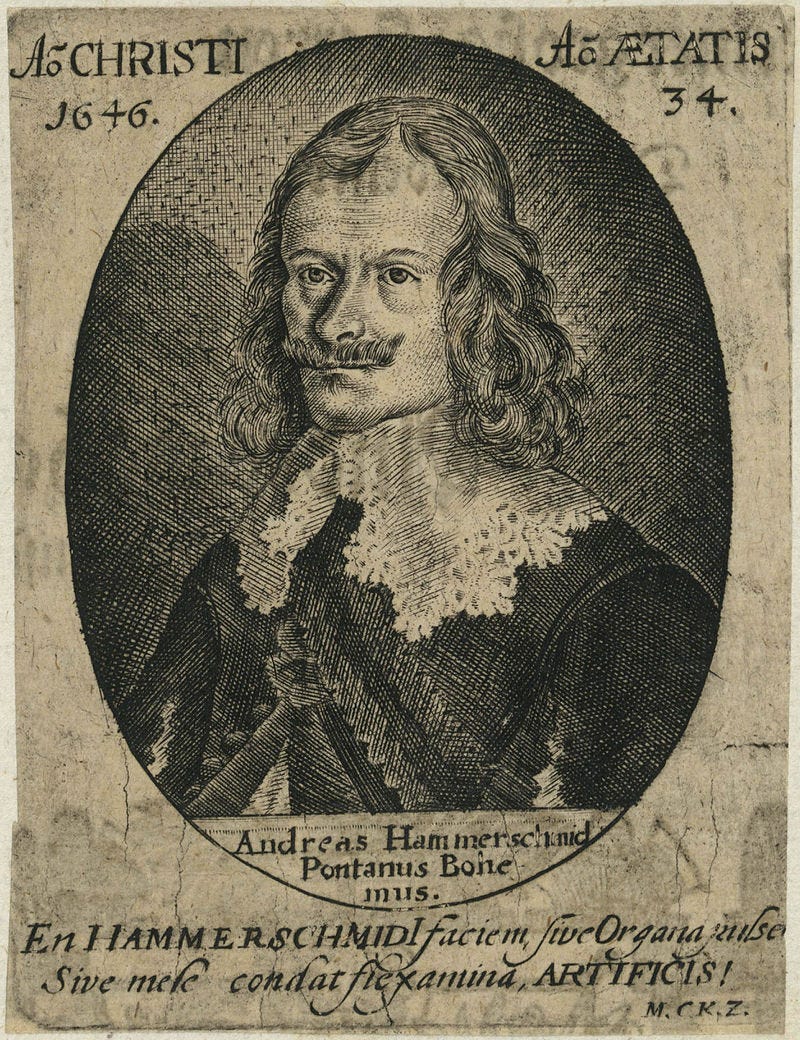
A prolific composer by the last two decades of his life he emerged as the best known German composer, his advice was sought on musical matters and his pieces were performed widely.
A prolific composer some 400 works have survived, including motets, dances, liturgical pieces, instrumental works and larger orchestral compositions. Ironically, given he spent his life as an organist none of his works for the organ have survived.
Today his music is rarely performed.
Enjoyed this period piece. Perhaps because it’s reminiscent of the sort of music we often hear in costume dramas on television or in the cinema.