
Carlo Gesualdo
1566-1611

Unlike many of the biographies we have featured in these pages, Carlo was neither a musical prodigy nor a man who used his talent to fight his way out of grinding poverty.
What he was, was the heir apparent to the Principality of Venosa in the centre of southern Italy, half way between Salerno and Bari.
But that was not how things started off.
Initially Carlo was sent to Rome for a religious education, it was assumed his elder brother was destined to become prince. Carlo would therefore have to settle for something religious, probably a cardinal’s hat. His uncle was already Dean of the College of Cardinals which would certainly have eased his path.
However his brother’s unexpected death in 1584 left Carlo as the Prince designate at the age of just 18. When his father died in 1591 Carlo became prince.
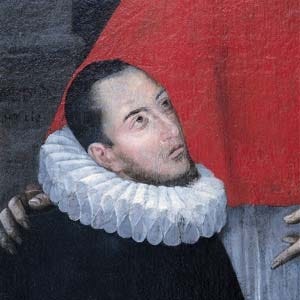
He married his first cousin, Donna Maria d'Avalos. Then in 1590, a year before he would become prince, he caught her red handed with her lover the Prince of Andria.
Without waiting to exchange pleasantries or to receive any sort of explanation, Carlo simply put both to the sword. A subsequent inquiry by the King of Naples decided that he had done nothing wrong.
You might have thought this would have put off any future bride, but no, he married again. The brave, or possibly foolhardy spouse was Leonora d’Este. By this time Carlo was already writing madrigals. But on moving with his new wife to Ferrara, then one of the musical centres of Italy, his compositions and his compositional style flourished.
As a wealthy prince, he was able to hire proficient musicians in Ferrara to test his pieces and but never to perform them for an audience.
From the 1590s things were beginning to go wrong for Carlo. By 1600 his marriage had broken down (although perhaps encouraged by the example of his first wife, she is said to have remained true to him) and his son by her had died.
He became depressed and had himself whipped daily by his servants. By 1611 his son from his first marriage had also died. Three weeks later Carlo died alone in his castle at Avellino.
He left behind an extensive collection of madrigals which were considered some of the most advanced of his time, as well as Tenebrae for the Passion and some instrumental pieces. His later music is said to be wracked with guilt and penitence.
Like most of our composers, his music is rarely performed today.