
Claudio Monteverdi
1567-1643

A son of Cremona, a city renowned for its production of stringed instruments to rival no others, Claudio showed a prodigious talent from an early age.
He did not come from a musical family, his father was a chemist and yet at least one of his siblings, his brother with the unlikely name of Gulio Cesare also became anaccomplished musician.
From an early age he was tutored by Marcantonio Ingegneri, the director of music at Cremona Cathedral and aged 15 had already started writing music.
He entered the University of Cremona and by 1591 had been appointed as a musician (he played the viola) to the Court of Mantua. It was here that he met and in 1599 married Claudia de Cattaneis, a singer in the court ensemble.
Monteverdi accompanied the Duke on military campaigns in Hungary and later in Flanders.
When the Duke was succeeded by his son Monteverdi once more found favour. He was commissioned to write his breakthrough work, the opera Orfeo in 1606. More commissions followed but at some point Claudio fell out with his patrons and when his wife died of smallpox in 1608 he returned to Cremona. Although he would work for the Duke again, the relationship never recovered.
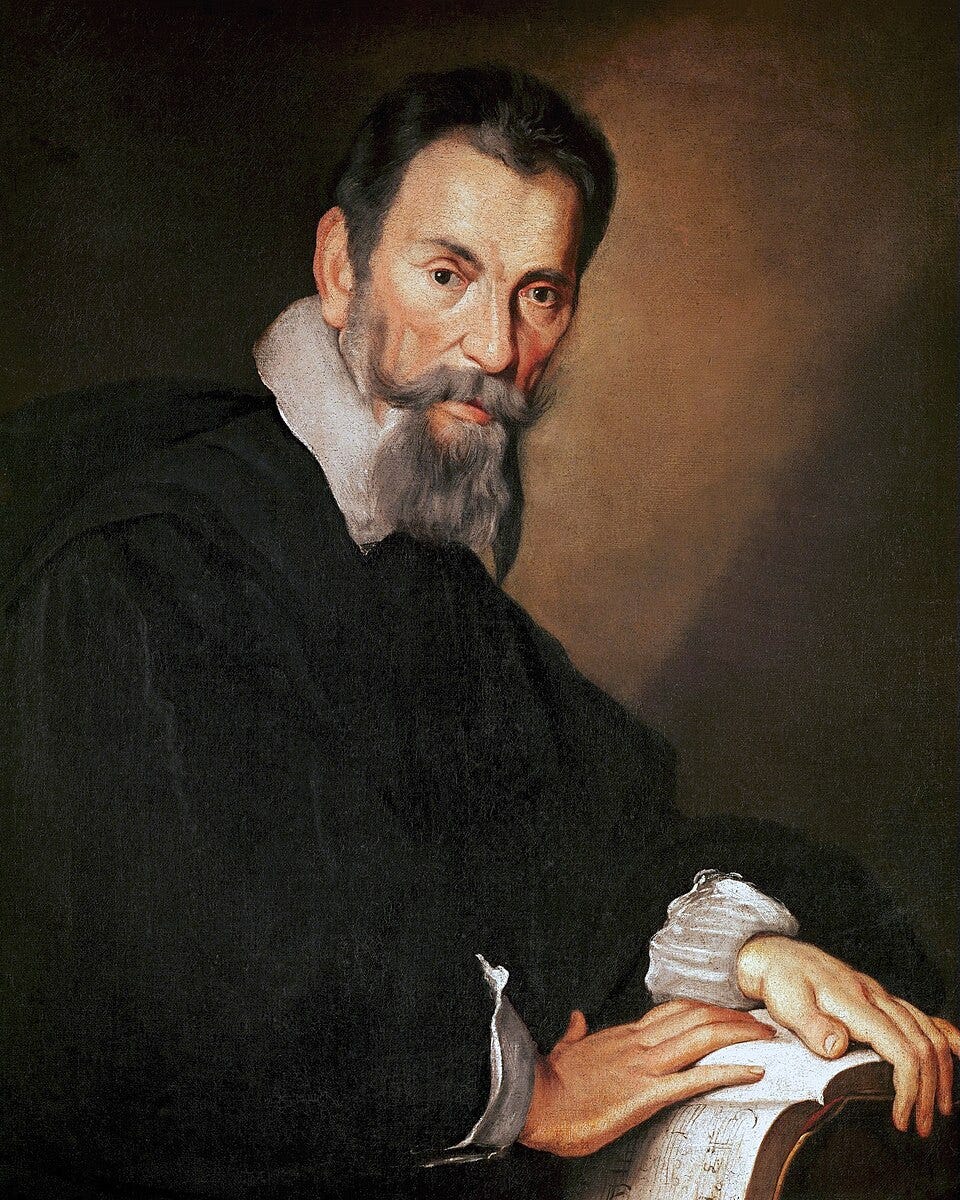
By 1613 Monteverdi had become maestro di cappella of St Marks in Venice a position he would cherish and hold until his death. He continued to be a prolific composer of both religiosu and secular music with notable refinements to established polyphonic compositions.
his own work encompassed a more emotional approach to music, both expressive and dramatic. And that can be found in moments of his religious music asd much as in his operas. As the piece that follows demonstrates.
Thank you, Her Kapellmeister. A great treat. 90 minutes of Monteverdi!