
Riccardo Broschi
1698 - 1756

Riccardo was born into a musical family. His father, Salvatore Brosca (the surname changed during his lifetime) was a composer himself and had held the position as maestro di cappella in the cathedrals of the Puglian cities of Andria and Barletta.
He seems to have prospered despite his humble origins, ending up as the as the governor in Maratea (1706) and Terlizzi (1709).
Riccardo’s date of birth is uncertain but he was born in Andria as were his two siblings, Dorothea and Carlo.
The family moved to Barletta in 1707 and then on to Naples in 1711. Here, the young Riccardo was enrolled in the Conservatorio di Santa Maria di Loreto.
Naples was one of the centres of music in Italy and here Riccardo enjoyed learning under an impressive collection of leading composers of the day such as Perugini and Mancini.
The death of his father at an early age in 1717 might have derailed the career of a lesser being. But his mother made him head of the household and faced with the responsibility to earn enough to keep the family, Broschi’s career blossomed.
Aside from earning from musical posts Broschi refined his skills as a composer. He seems to have settled on a preference for writing opera pretty much from an early age. Initially he wrote smaller scale vocal pieces.
The opera scene in Naples was highly competitive, just getting a chance to have your work was performed was hard enough.
His debut in the autumn of 1725 was with “La Vecchia sorda” which was put on at the Teatro dei Fiorentini.
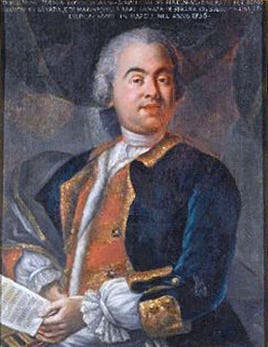
Perhaps sensing this he moved to Rome, where five more operas followed with premieres around Italy. These established his reputation.
Riccardo had a secret weapon when it came to composing. His brother, the young Carlo was turning into one of the finest castrati singers of his (or any other) age. We know him, not so much as Carlo Broschi, but as Farinelli.
As Broschi’s reputation grew and his operas started to get staged around Europe. He took posts (mostly briefly) at various courts ostly in Germany before returning to Naples in 1737. On his return he was immediately appointed as maestro to the Royal Chapel before moving on once more to the Royal Court in Madrid in 1739. Here he remained until his death.
Not so struck on this, rather warbly castrato type singing, maybe better to hear it live (though not with castrato!)
I enjoyed this. And yes, Barry has a point. But good to listen to the work of, for me, another talented unknown composer.