
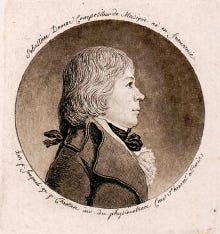
Sébastien Demar
1763-1832

Born in the Bavarian town of Gauaschach in what was then the Holy Roman Empire Sébastien was born into a musical family, his father was a music teacher. However he received his musical education, not at home, but under Franz Xaver Richter Kapellmeister of Strasbourg Cathedral.
His brother Joseph was also a talented musician who secured a post as a violinist at the chapel of the Grand Duke of Würzburg.
His biography is surprisingly sketchy for a renowned musician of the 18th/19th century. We know he became an organist and music teacher in the city of Weißenburg and that he travelled to Vienna where he studied under Joseph Haydn.
Was he a revolutionary idealist? Certainly he moved to Paris in 1788/89 as the Revolution was gaining ground before moving on to Orléans, where he settled. He would remain there until his death.
By 1791 he was directing the music of the 88th Regiment and then the National Guard units of Orléans. By 1799, he had been appointed to play the organ at Republican festivals, in the various “temples” where they were held. Usually old churches the plain song of the past was replaced with war songs of the Revolution.
1806 he founded the Société of the Concerts par Abonnement. He acted as conductor to the Société orchestra. In 1815 he was appointed as the organist to Saint Paterne.
He seems to have allowed his musical career to chop and change with the times, securing posts during the Revolution, the Reign of Terror, the Empire and finally under the restored monarchy.
He was a prolific composer, mainly of concertos, but also trios and shorter studies and pieces.
Sébastien Demar died in Orléans in July 1832.
Yes, thia sounded like teenage Mozart to start with, still pretty good, but got even better as it went along. Earlier part of his life coincided with Mozart.
Also, yet another peripatetic musician, following the work, as musicians seem to have done from middle ages to today!
I agree with Helene. Clear influence of Mozart. Nothing wrong with that.